
Fiberglass Reinforced Plastic (FRP)
Cooling Towers
Cooling Tower Materials
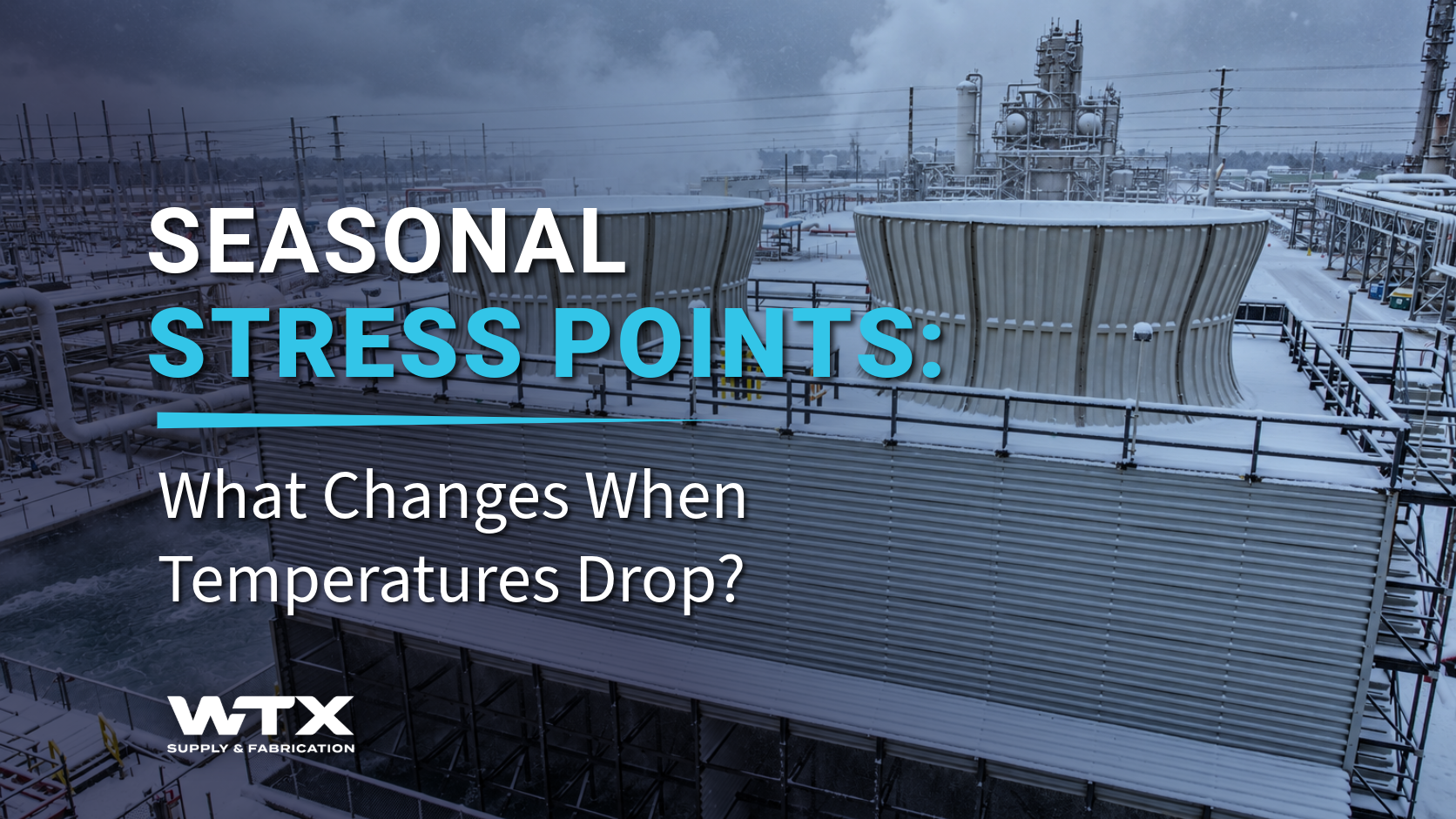

Cooling towers do not stop facing operational stress when summer ends. The stress simply changes.
During warmer months, facility teams are often focused on heat rejection, peak cooling demand, water consumption, and keeping equipment operating reliably under load. As outdoor temperatures fall, a different set of considerations comes into focus.
Lower ambient temperatures can increase the potential for ice formation, change how a tower needs to be operated, and make existing component issues more important to identify. At the same time, seasonal changes in operating schedules can introduce concerns related to stagnant water, water treatment, shutdown procedures, and future maintenance needs.
Understanding these seasonal stress points can help maintenance and operations teams prepare for colder weather while giving procurement teams more time to address replacement-part needs before they become urgent.
Cooling towers rely on the interaction of water and air to reject heat. When the surrounding air becomes colder, the conditions under which that heat transfer occurs change as well.
One of the most visible concerns is ice formation.
The Cooling Technology Institute (CTI) recommends implementing an appropriate winter operating plan as ambient temperatures fall and emphasizes operator inspection and control during cold-weather operation. Its winterization guidance specifically identifies areas such as louvers and fill as important locations to observe for ice formation. CTI also notes that heat load, circulating water flow, and airflow all play a role in managing icing. Cooling Technology Institute: Recommendations for Winterizing Cooling Towers
Equipment-specific requirements matter. For example, SPX Cooling Technologies' Marley operating guidance notes that ice may form on relatively dry portions of a tower exposed to incoming air during low-temperature operation and that icing characteristics vary based on factors including wind, circulating-water rate, and heat load. SPX Cooling Technologies: Marley F400 Cooling Tower User Manual
The takeaway is not that every cooling tower should be operated according to one temperature or procedure. It is that cold-weather operation requires deliberate planning and monitoring based on the specific tower and system.
Facility teams should follow the cooling tower manufacturer's operating instructions and the site's established cold-weather operating procedures.
Visible ice on the tower is only part of the cold-weather conversation.
Water left in exposed piping, basins, coils, or other equipment can potentially freeze when equipment is shut down or operated intermittently in freezing conditions. Expansion from freezing water can damage components and piping.
That makes shutdown strategy particularly important.
Manufacturer guidance may require draining certain equipment or protecting it through other means when it is not operating. For example, SPX guidance for intermittent freezing-weather operation calls for water to be drained from tower piping to protect against freezing and possible rupture. Closed-circuit equipment can have additional requirements. SPX recommends appropriate freeze protection for fluid-cooler coils because a frozen coil can be damaged or rupture. SPX Cooling Technologies: Fluid Cooler Cold Weather Operation
Before temperatures fall below freezing, teams should understand:
The correct approach depends on the equipment and application, which is why the manufacturer's recommendations should always guide the site's specific procedure.
Cold weather does not necessarily create every problem discovered during fall and winter. In many cases, it provides an opportunity to find conditions that developed during the previous operating season.
Months of operation can leave behind scale, sediment, corrosion, biological growth, damaged components, or other maintenance needs.
The CDC identifies sediment, scale, corrosion, and biofilm as important conditions to control in cooling tower systems. Its cooling tower guidance recommends maintaining an appropriate water-management program and following manufacturer recommendations for cleaning and disinfection around startup, idling, and shutdown. CDC: Controlling Legionella in Cooling Towers
A seasonal inspection can therefore provide useful information for upcoming maintenance planning.
Depending on the tower and the scope of the inspection, areas worth evaluating may include:
The goal is not simply to create a list of worn components. It is to understand what needs immediate attention, what should be monitored, and what should be planned for the next maintenance period.
When cooling demand decreases, it can be tempting to think primarily about freeze protection. Water distribution, however, remains an important part of cooling tower operation.
Proper water flow helps support the tower's intended performance and can also influence cold-weather operation.
CTI's winterization guidance recommends maintaining circulating-water flow as part of managing ice formation during cold-weather operation. The exact requirements depend on tower design and operating conditions. Cooling Technology Institute: Recommendations for Winterizing Cooling Towers
That makes damaged or clogged nozzles, distribution issues, and other flow-related problems worth addressing rather than carrying them into winter.
For maintenance teams, this is another reason seasonal inspections should look beyond only the most obvious signs of physical damage.
Some facilities operate cooling towers year-round. Others reduce operation, cycle equipment, idle individual cells, or shut systems down seasonally.
Those changes matter for more than freeze protection.
Water stagnation can contribute to conditions that support microbial growth. CDC cooling-tower guidance recommends avoiding stagnation, maintaining appropriate water treatment, and managing low-flow or dead-leg areas as part of a comprehensive water-management program. For wet-system standby, CDC provides specific circulation and treatment recommendations and advises facilities to follow established water-management procedures. CDC: Controlling Legionella in Cooling Towers
The CDC also recommends cleaning and disinfecting cooling towers as directed by the manufacturer before startup, when idling, and after shutdown, along with at least annual offline cleaning and disinfection. CDC: Controlling Legionella in Cooling Towers
For facilities transitioning equipment into seasonal or intermittent operation, water management should therefore be part of the shutdown conversation rather than an afterthought.
One of the practical benefits of fall and winter inspections is time.
If an inspection identifies damaged fill, deteriorated drift eliminators, clogged or damaged nozzles, worn louvers, missing hardware, or another component that will need replacement, the facility may have an opportunity to address that need before the next period of high cooling demand.
That changes the procurement conversation.
Instead of waiting until a component becomes an urgent operational problem, teams can begin identifying:
For procurement and maintenance teams, that additional planning time can make it easier to coordinate upcoming maintenance and reduce last-minute sourcing.
Spring maintenance may seem far away when temperatures first begin to drop, but the information gathered during fall inspections can become the foundation of the next maintenance cycle.
Inspect → Document → Prioritize → Specify → Source → Schedule
Inspection identifies the condition.
Documentation establishes what was found.
Prioritization separates immediate concerns from planned maintenance.
Specifications determine exactly what replacement components are needed.
Sourcing confirms availability and lead times.
Scheduling brings the parts, labor, and maintenance window together.
By starting that process earlier, teams have more time to make informed decisions rather than reacting to an urgent need once cooling demand returns.
Inspect → Document → Prioritize → Specify → Source → Schedule
→ Inspection identifies the condition.
→ Documentation establishes what was found.
→ Prioritization separates immediate concerns from planned maintenance.
→ Specifications determine exactly what replacement components are needed.
→ Sourcing confirms availability and lead times.
→ Scheduling brings the parts, labor, and maintenance window together.
By starting that process earlier, teams have more time to make informed decisions rather than reacting to an urgent need once cooling demand returns.
Seasonal changes are a reminder that cooling tower maintenance is not limited to peak summer operation.
As temperatures drop, facilities may need to adjust operating practices, manage freeze and icing risks, maintain water-treatment controls, evaluate equipment condition, and begin planning for upcoming maintenance.
The specific requirements will vary by cooling tower, facility, climate, and operating strategy. Always follow equipment-manufacturer guidance, site-specific operating procedures, and the facility's water-management program.
When those inspections and maintenance plans identify cooling tower parts that need to be replaced, WTX Supply & Fabrication can help turn the findings into a sourcing plan.
From fill media and drift eliminators to nozzles, louvers, hardware, and other cooling tower components, our team can help you identify and source the materials you need for planned maintenance and repair projects.
Planning ahead for your next cooling tower project?
Contact WTX Supply & Fabrication to discuss your parts and material needs.