
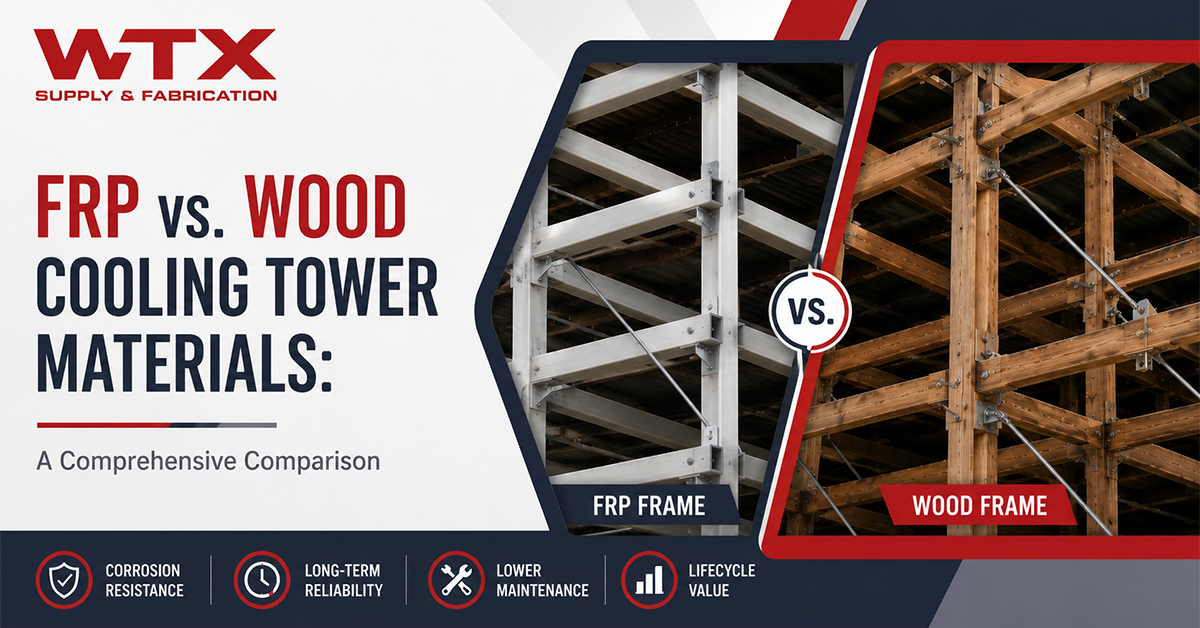

FRP vs. Wood Cooling Towers: Which Material Makes Sense for Your Operation?
Cooling tower performance depends on more than design and maintenance. The materials used throughout the system directly impact lifespan, maintenance costs, structural integrity, and long-term operational reliability.
One of the most common questions facility teams face during repairs, rebuilds, or upgrades is whether to use FRP or wood components.
The answer depends on your operating environment, maintenance goals, budget, and long-term plans.
In this guide, we break down the real-world differences between FRP and wood cooling tower components, including cost considerations, durability, maintenance requirements, and where each option performs best.
FRP vs. Wood Cooling Towers: Quick Answer
FRP cooling tower components are typically better for long-term durability, corrosion resistance, and reduced maintenance in harsh industrial environments. Wood cooling tower components are often more cost-effective upfront and remain a practical solution for existing wood tower systems or budget-sensitive repairs.
The best choice depends on:
- Operating environment
- Moisture exposure
- Maintenance expectations
- Downtime tolerance
- Lifecycle cost goals
- Existing tower design
Facilities prioritizing long-term reliability and reduced maintenance often choose FRP. Facilities managing short-term repair costs or maintaining existing wood systems may continue using wood.

Need help evaluating FRP vs. wood for your cooling tower?
Understanding the Difference Between FRP and Wood
What is FRP?
FRP, or Fiberglass Reinforced Plastic, is a composite material designed for industrial environments where moisture, corrosion resistance, and structural durability matter.
FRP components are commonly used in:
- Structural framing
- Decking and platforms
- Fan stacks
- Louvers
- Casing panels
- Access systems
- Pultruded fiberglass supports
Because FRP does not rot, absorb moisture, or corrode like traditional materials, it has become a preferred choice for many cooling tower upgrades and rebuilds.
What is Wood Used For in Cooling Towers?
Wood has been used in cooling tower construction for decades and is still commonly found in many industrial facilities.
Typical cooling tower lumber applications include:
- Structural framing
- Decking
- Louver arms
- Trays
- Support components
- Redwood and Douglas Fir assemblies
Wood remains a practical solution in many environments, especially when facilities are maintaining existing wood tower systems or working within tighter short-term budgets.
Upfront Cost vs. Long-Term Cost
One of the biggest misconceptions in cooling tower material selection is focusing only on initial purchase price.
Wood Often Has Lower Upfront Costs
Wood components generally carry a lower initial material cost compared to FRP. For facilities managing immediate repair needs or operating within strict capital budgets, wood can appear to be the more economical option.
FRP Typically Reduces Long-Term Maintenance Costs
While FRP usually costs more upfront, many facilities see lower long-term ownership costs because FRP:
- Resists moisture damage
- Does not rot
- Requires less maintenance
- Handles harsh environments more effectively
- Reduces replacement frequency
- Performs well in chemically aggressive applications
In many industrial environments, the reduction in downtime, repairs, and recurring replacement costs can offset the higher upfront investment.

Planning a Cooling Tower Upgrade?
Durability and Environmental Performance
Cooling towers operate in challenging conditions that expose materials to constant moisture, chemical exposure, UV radiation, and temperature fluctuations.
Where FRP Performs Best
FRP is typically the preferred option for:
- High-moisture environments
- Chemical processing facilities
- Refineries
- Power generation operations
- Coastal or corrosive environments
- Facilities focused on long-term lifecycle planning
- Lower-moisture environments
- Existing wood tower systems
- Budget-sensitive repairs
- Facilities requiring short-term replacement solutions
Because FRP resists corrosion and moisture intrusion, it maintains structural integrity longer in demanding environments.
Where Wood Still Makes Sense
Wood can still be an effective material choice in:
- Lower-moisture environments
- Existing wood tower systems
- Budget-sensitive repairs
- Facilities requiring short-term replacement solutions
When properly maintained, wood components can continue performing reliably in many cooling tower applications.
Maintenance Considerations
Maintenance requirements often become the deciding factor between FRP and wood.
Wood Maintenance Requirements
Wood systems typically require more ongoing inspection and maintenance due to:
- Moisture absorption
- Rot potential
- Biological growth
- Structural degradation over time
- Frequent repair or replacement cycles
- Resist rot and decay
- Hold up well in wet environments
- Maintain structural consistency
- Resist many corrosive chemicals
- Reduce recurring replacement needs
Facilities operating older wood towers may already have maintenance programs in place to manage these concerns.
FRP Maintenance Advantages
FRP components generally require less routine maintenance because they:
- Resist rot and decay
- Hold up well in wet environments
- Maintain structural consistency
- Resist many corrosive chemicals
- Reduce recurring replacement needs
For operations prioritizing reduced downtime and predictable maintenance planning, FRP often delivers long-term operational advantages.
Reduce Maintenance With the Right Components
From FRP structures and access systems to replacement hardware and fabricated parts, WTX helps facilities minimize downtime and improve long-term cooling tower reliability.
FRP vs. Wood Cooling Towers: Frequently Asked Questions
Compare Your Options With WTXSF
If you're evaluating a repair, rebuild, or full cooling tower upgrade, our team can help identify the most cost-effective solution based on your operational requirements.
Questions to Ask Before Choosing FRP or Wood
There is no universal answer for every cooling tower system. The right material depends on your facility’s specific operating conditions and long-term goals.
Before making a decision, consider:
- What environment is the tower operating in?
- What maintenance issues are currently occurring?
- Is downtime becoming a recurring problem?
- What is the expected lifespan requirement?
- Is the goal short-term repair or long-term upgrade?
- Are corrosion or moisture issues accelerating failures?
- What are the total lifecycle costs over time?
At WTX Supply & Fabrication, we help customers evaluate these factors based on operational realities, not just material pricing.
Common Mistakes Facilities Make
One of the most common mistakes is selecting materials based strictly on upfront price instead of total operating impact.
A lower-cost repair today can become a much more expensive maintenance issue over time if the material is not suited for the operating environment.
Facilities should evaluate:
- Downtime risk
- Maintenance labor
- Replacement frequency
- Structural lifespan
- Environmental exposure
- Long-term operational efficiency
Material selection should support reliability, not just short-term savings.
A Real-World Example
A customer operating in a high-moisture industrial environment originally selected wood components to reduce initial project costs.
Within a few years, the facility experienced:
- Increased structural deterioration
- More frequent repairs
- Higher maintenance labor
- Unexpected downtime
- Accelerated replacement cycles
After transitioning to FRP components, the operation improved long-term reliability while reducing recurring maintenance issues.
FRP vs. Wood Cooling Towers Comparison Table
| FRP | Wood | |
| Upfront Cost | Higher | Lower |
| Long-Term Maintenance | Lower | Higher |
| Corrosion Resistance | Excellent | Moderate |
| Moisture Resistance | Excellent | Limited |
| Expected Lifespan | Longer in harsh environments | Depends heavily on maintenance |
| Retrofit Compatibility | Excellent | Common in legacy systems |
| Best For | Long-term reliability and aggressive environments | Budget-focused repairs and existing wood towers |
WTXSF Recommendation Framework
At WTX Supply & Fabrication, we typically recommend:
FRP When:
- Long-term durability is the priority
- Moisture exposure is severe
- Corrosion resistance is critical
- Downtime reduction matters
- Facilities want lower lifecycle maintenance
- Environmental conditions are aggressive
- Maintaining existing wood tower systems
- Working within short-term repair budgets
- Environmental conditions are less aggressive
- Immediate replacement needs take priority
Wood When:
- Maintaining existing wood tower systems
- Working within short-term repair budgets
- Environmental conditions are less aggressive
- Immediate replacement needs take priority
Every cooling tower application is different. The best solution comes from evaluating operational goals, maintenance history, and long-term performance expectations.
Need Help Choosing the Right Cooling Tower Materials?
WTX Supply & Fabrication provides cooling tower lumber, FRP components, custom fabrication, and technical support for industrial facilities nationwide.
Whether you are repairing an existing system or planning a long-term upgrade, our team can help you evaluate the right materials for your environment and operating goals.
Talk to the WTXSF Team
Get expert guidance on FRP, cooling tower lumber, structural components, and replacement solutions designed for long-term performance.
Request a Quote or Speak with a Specialist Today